The 6-hour smart charging update is rolling out now.
Ohme and Octopus Energy are rolling out the new 6-hour smart charging update together. Everyone who has the 6-hour smart charging limit in place will have the setting available – if you haven’t seen it yet, it’s on its way.
Make sure you’re on the latest version of the Ohme app so you’re ready when it’s enabled for you. Your existing setup will continue to work as normal in the meantime.
Last updated: 4th August 2026
Read time: 6 minutes
Required app version: 2.18.0 or later
Jump to:
What you get with Intelligent Octopus Go
Choose what to prioritise
How Ohme decides when and how fast to charge
Max charging
Tips to make the most of your 6 hours
Intelligent Octopus Go is designed to help EV drivers reduce charging costs by making use of off-peak electricity through smart charging. Octopus Energy provides up to 6 hours of super cheap smart charging every 24 hours for your EV. The 6 hours will be issued from 12pm – 12pm (midday one day until midday the following day).
All Max charging will be billed at peak rates, this is true even between 11:30pm – 5:30am.
If you use a compatible smart charger, such as Ohme, you can choose how your charging is handled. You can limit charging to stay within the 6 hours, or you can prioritise reaching your chosen target, which may mean some charging is billed at the peak rate.
If you plug in regularly and top up overnight, this change shouldn’t affect how much you pay.
Once your 6 hours of super cheap smart charging are used, any further charging will be billed at your peak rate, even if it happens during the 11:30pm–5:30am window.
What you get with Intelligent Octopus Go
With Intelligent Octopus Go, you receive:
- 6 hours of off-peak electricity for your household, every day between 11:30pm and 5:30am
- Including up to 6 hours of super cheap smart charging for your EV per day, which may be scheduled:
- during the 11:30pm–5:30am off-peak window
- outside that window
- or across a mix of both
Example scenario: Charging across the evening and night.
If you plug in at 6pm and Octopus schedules charging through Ohme at the following times:
- 6pm–7pm
- 8pm–10pm
- 10:30pm–12:30am
- 1am–3am
This adds up to 7 hours of smart charging.
- The first 6 hours are billed at off-peak rates
- The final hour is billed at peak rates
Even though the last hour happens overnight, it is charged at the peak rate because the 6 hours of super cheap smart charging have already been used.
Choose what to prioritise
At Ohme, our goal is to make charging your EV simple, smart, and sustainable. Our chargers are designed to automatically find the cheapest and greenest times to charge, while always keeping you in control of how and when your car charges.
Smart charging keeps costs low by scheduling charging during off-peak times whenever possible. Some drivers are happy to limit how much they charge each day, while others want the certainty that their car will reach the target they’ve set, even if that means paying a little more.
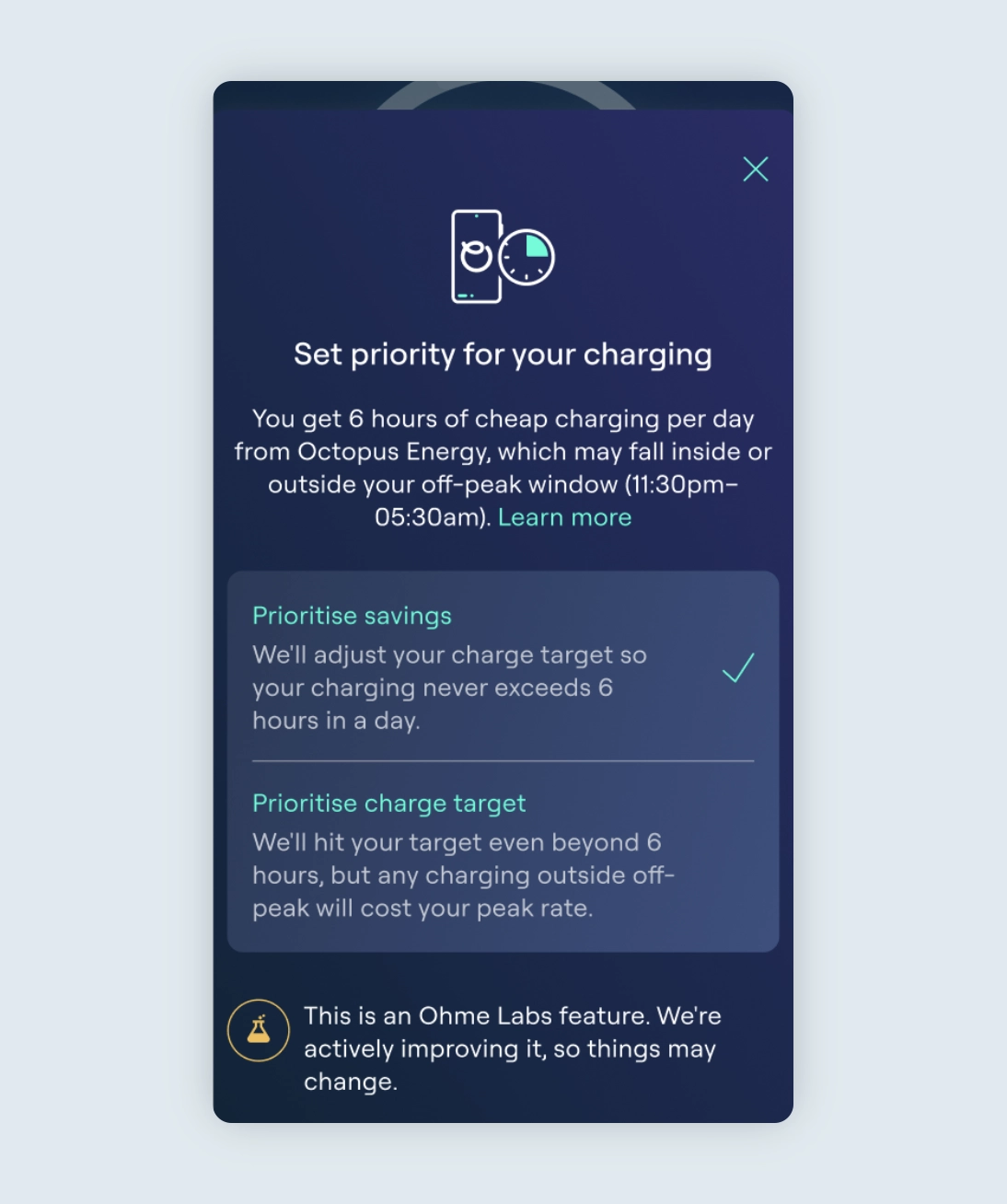
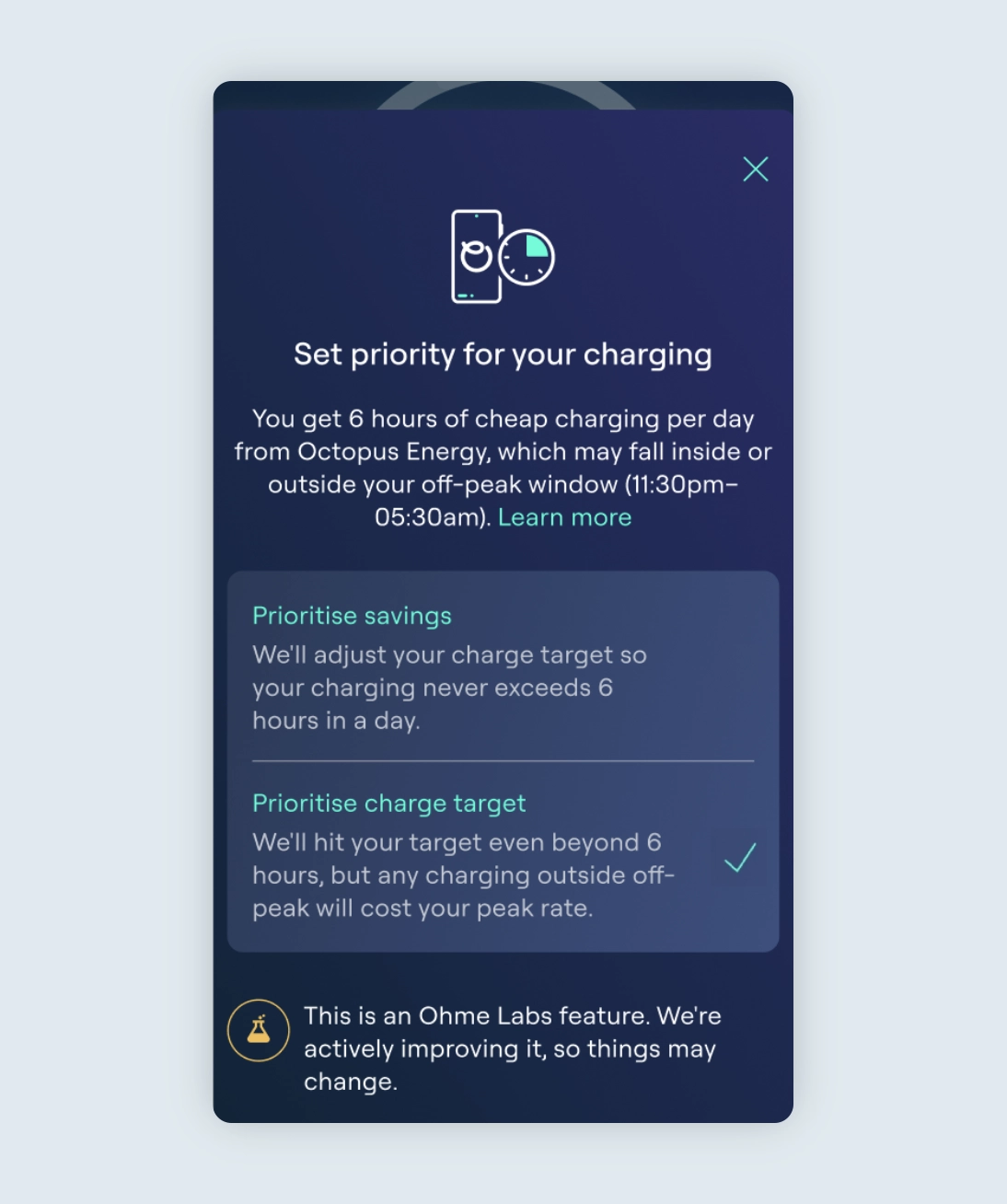
The Ohme app lets you choose how your charging is handled. Once you’ve connected your Ohme account to the Intelligent Octopus Go tariff, you’ll find this on the charging screen under Prioritise.
Option 1: Prioritise savings
If you choose Prioritise savings:
- Ohme will limit smart charging to a maximum of 6 hours per day.
- Charging will stop once those 6 hours are used.
- This prevents any charging at peak rates.
This option is best if:
- Your daily charging fits comfortably within 6 hours.
- You want to avoid charging at peak-rates.
Ready-by times after midday
If your car is plugged in with a ready-by time after 12 noon, the schedule shown may not include all the smart charging time that will become available after midday.
Your 6-hour smart charging allowance runs from midday to midday. When Ohme first creates your schedule, it uses the allowance remaining for the current period. After midday, Ohme automatically creates a new schedule using the allowance available for the new period. This usually happens after the first meter reading received after 12 noon.
You do not need to unplug your car or change its schedule. Keep it plugged in and Ohme will reschedule it automatically.
Note: Charging scheduled after midday counts towards the new period’s 6-hour allowance, even if it was included in the schedule created before midday.
Note: Depending on your battery size, starting charge level and target, Ohme may lower your charging target if it can’t be reached within the 6-hour charging limit.
Option 2: Prioritise charge target (The default setting)
If you choose Prioritise charge target:
- Ohme will aim to reach the charge target you have set.
- Charging may continue beyond 6 hours if needed.
- The first 6 hours are billed at off-peak rates.
- Any charging beyond that is billed at peak rates.
This option is best if:
- You need more energy than 6 hours of charging can deliver.
- You are happy to accept some peak-rate charging to reach your target.
How Ohme decides when and how fast to charge
After plugin, Octopus and Ohme create a smart charging schedule to charge at the fastest rate your car and home setup allow. If charging is slower than expected this could be due to a few common reasons.
Car settings
Your EV always has the final say on how fast it will charge.
If your car has:
- A charge-rate limit set in the vehicle settings
- Battery protection that reduces charging speed
- Other manufacturer limits
Ohme cannot override this.
Ohme will still schedule charging at the fastest possible rate, but your car will only accept the rate it allows. This can reduce how much charge you receive within the 6-hour discounted period.
Load Balancing
All Ohme chargers include a built-in safety feature called Load Balancing. This is a standard requirement for smart EV chargers in the UK and helps protect your home’s electrical supply.
Load Balancing monitors your home’s total electricity use and automatically adjusts EV charging to prevent your main fuse from being overloaded. A small sensor called a CT clamp measures household usage, including appliances such as ovens, kettles, and other high-power devices.
If total demand gets close to your fuse limit, Ohme reduces the charging power. When household demand drops again, for example when appliances are switched off, charging returns to the scheduled rate. This behaviour is expected for UK smart charge points and helps keep your home’s electrical system operating safely.
For example:
- Your charger may start the session charging at the scheduled rate
- If several high-power appliances turn on, Ohme will reduce the charging speed to accommodate the additional load
- Once those appliances turn off, Ohme will resume the scheduled rate of charge
This adjustment happens automatically and are a normal part of safe EV charging.
During busy periods in the home, charging may be slowed to protect your electrical supply. As a result, you may receive less charge during your 6 hours of off-peak smart charging.
Charger safety
Ohme chargers constantly monitor the voltage at your property to make sure charging stays safe.
UK single-phase EV chargers are designed to operate at 230V, with a tolerance of plus or minus 10%. This means the safe operating range is typically 207V to 253V, in line with UK guidelines for 7kW EV charging. More information can be found here: Residential chargepoints: minimum technical specification.
If the voltage at your property:
- rises above 253V, or
- drops below 207V
the charger will temporarily pause charging and the charger will display an error. This protects both your vehicle and your home’s electrical system. Once the voltage returns to a safe level, charging will automatically resume. This behaviour is normal and helps ensure safe, reliable charging.
Max charging
Max charge is a manual override to start charging immediately at the fastest rate until your car is full. Ohme will also Max charge if the charger is offline at the time of plugin, to ensure you car is charged even if it is unable to communicate with the Ohme app. All Max charging will be billed at peak rates, this is true even when charging between 11:30pm – 5:30am.
Tips to make the most of your 6 hours
Most drivers will find their daily top-up fits within the 6 discounted hours.
To get the best results:
- Plug in daily when possible, even if you only need a small top-up
- Avoid letting your battery drop very low before charging. Plugging in more often can help
- Use shorter, more frequent charging sessions rather than long infrequent ones. This is often referred to as graze charging
- If you have more than one EV, consider alternating charging nights between vehicles